
Greeley Projected Versus Actual Release
KASPER uses the exact field name Anticipated release date. It is a prospective field calculated from the sentence information known to KDOC. It can change before the release event. The actual release date is recorded only after the custodian completes the transaction. A movement date can also reflect transfer between facilities rather than release to the community.
A county case follows another path. A sentenced person serving time in the Greeley County Jail may have an expected end tied to the court judgment and jail credit, but Greeley County publishes no online projected-date field or local good-time policy. Ask the sheriff which facility physically holds the person, then use the sentencing journal entry and the holder’s record. A pretrial person has no sentence-based date. Bond approval is legal authority to begin release processing, not the door-out time.
| Date or status | What it means | What it does not prove |
|---|---|---|
| Anticipated release date | KDOC’s current prospective estimate | That release occurred on that date |
| Parole eligibility | First possible consideration under the applicable law | A favorable decision or prison exit |
| Movement date | A recorded change of facility or status | Release to the community |
| Discharge date | End of the shown KDOC sentence or jurisdiction | That no other authority has a case |
Find a Greeley Projected Release
First identify whether the person is held for a county case, a state-prison sentence, or another authority. The KASPER search is appropriate only for KDOC custody, supervision, and qualifying historical records. It is not an index of every Greeley County arrest. Search by KDOC registration number when known. A name search requires identity checks because matching names can belong to different people.
- Confirm the current custodian. Ask the Greeley County Sheriff whether the person was held locally, housed elsewhere, or transferred.
- For a KDOC prisoner, accept the KASPER disclaimer, search, compare identity details, and open the matching record.
- Copy “Anticipated release date” exactly as shown and preserve the access date. Also record status, facility, movement dates, sentence fields, and supervision information.
- For a county sentence, obtain the sentencing journal entry, jail-credit information, and the physical holder’s projected or actual release record.
- For a disputed state calculation, contact KDOC Sentence Computation at (785) 296-3317 with the KDOC number and controlling case details.
The KDOC locating FAQ explains that KASPER includes people sentenced to the Secretary of Corrections since 1980 who are incarcerated, on post-incarceration supervision, or discharged. It is updated daily except weekends and omits Kansas people held through interstate compact. Not every record displays every date. Old records generally remain unless a conviction is overturned, expunged, or affected by executive clemency.
County custody needs a narrower request. Give the sheriff the full name, date of birth if known, arrest or booking date, and court case number. Ask whether Greeley County physically held the person or placed them elsewhere. If another jail held the person, that jail controls its own release transaction. Greeley County still holds its arrest and court records. This split is important because the Kansas Sheriffs’ Association lists only three local jail spaces, but no official source identifies a routine receiving county. The small capacity supports asking about a transfer; it does not support naming a destination without a case-specific record.
Greeley KASPER Release Fields
KASPER’s detail page must be read as a set. The official field inventory can include name, KDOC number, date of birth, physical traits, markings, photograph, convictions, county, case number, placement information, and facility movements. Sentence fields can include sentence-begins date, anticipated guidelines release date, parole eligibility, conditional release, and sentence expiration. The displayed status may state incarceration, parole, conditional release, postrelease supervision, compact supervision, or discharge.
| Field | How to use it |
|---|---|
| KDOC registration number | Use as the main identity key for search and agency contact. |
| Status | Distinguish prison custody, community supervision, and discharge. |
| Anticipated release date | Treat as a dated estimate and quote the label exactly. |
| Facility movement | Build the custody timeline without calling every movement a release. |
| Maintaining parole office | Identify the state office responsible after institutional release. |
| County and case number | Connect the corrections record to the sentencing court file. |
A KASPER photo helps compare identity but does not prove current custody by itself. Likewise, an old anticipated date does not show what happened later. Read the current status and movement history, then request KDOC confirmation when an exact release or discharge is important.
The date fields answer different legal questions. Parole eligibility is the first point at which an eligible older-law prisoner may be considered. A hearing date identifies the proceeding, and a Board decision records its outcome. Conditional release and sentence expiration arise from the controlling Kansas sentence rules. Supervision start or end dates describe community control after prison. Keeping those terms intact prevents a future eligibility month from being reported as a scheduled exit or a supervision start from being treated as full discharge.
Greeley Good-Time Release Rules
Kansas guidelines prison sentences represent actual time subject to good time authorized by statute. For crimes on or after July 1, 1993, K.S.A. 21-6821 generally caps the good-time reduction at 15 percent of the prison portion. This produces the familiar shorthand that about 85 percent is served. The same statute permits a 20 percent maximum for specified lower-severity nondrug and drug categories and dates. It also permits eligible program credits of up to 120 days for defined classes.
Those ceilings are not promises. Credits may be earned, forfeited, restored, or unavailable under the person’s sentence and conduct. Special provisions apply to certain sexually violent or sexually motivated crimes. Court amendments, jail credit, consecutive sentences, revocation, and other legal facts can also affect the calculation. Do not subtract 15 percent from a sentence reported in a news item and call the result a release date.
K.S.A. 21-6806 provides that a guidelines prison sentence is actual time subject to authorized good time. That rule must be read with the credit limits, the sentencing journal entry, and the person’s KDOC computation. It does not establish how much credit an individual has earned. The matching statute capture shows the guidelines-sentence rule:
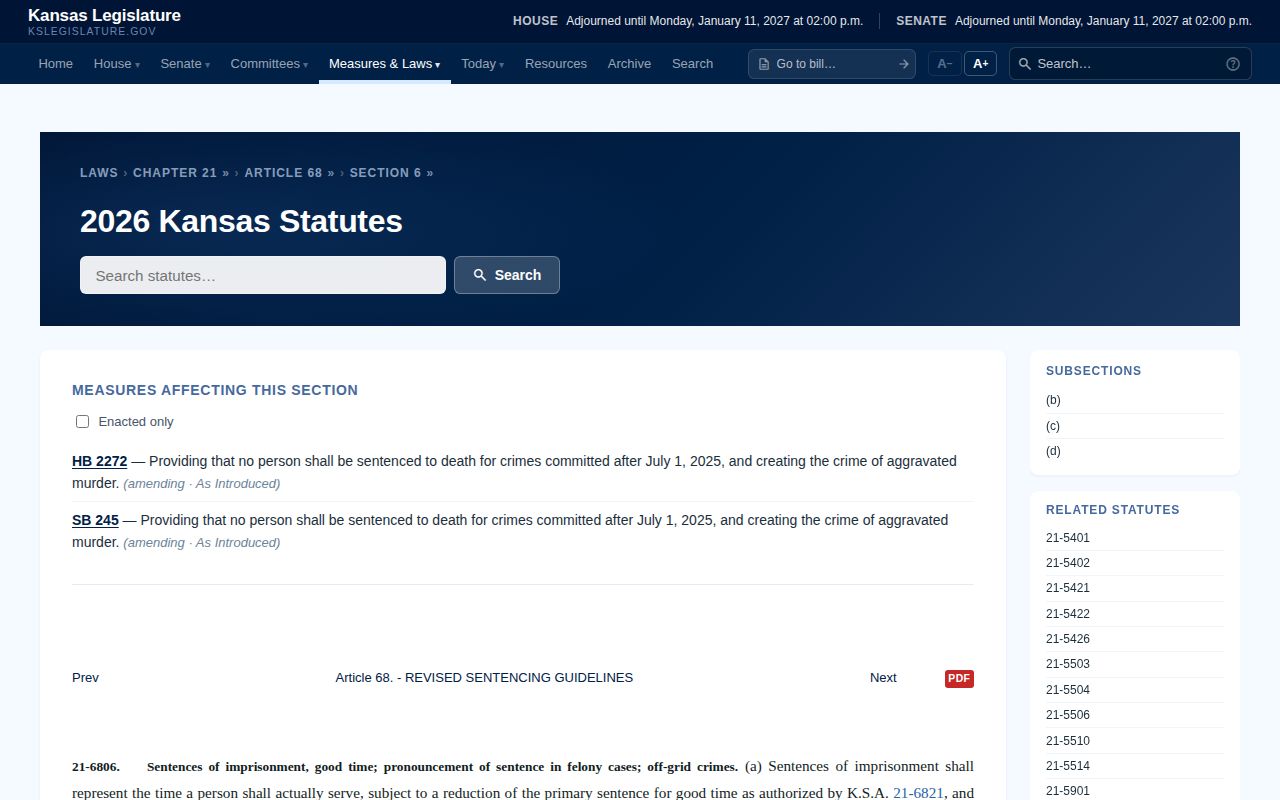
The image supports the legal framework, but only the corrections record can show the current estimate produced from the person’s cases and credits.
The statute page shows the actual credit framework behind a Greeley County state-prison estimate:
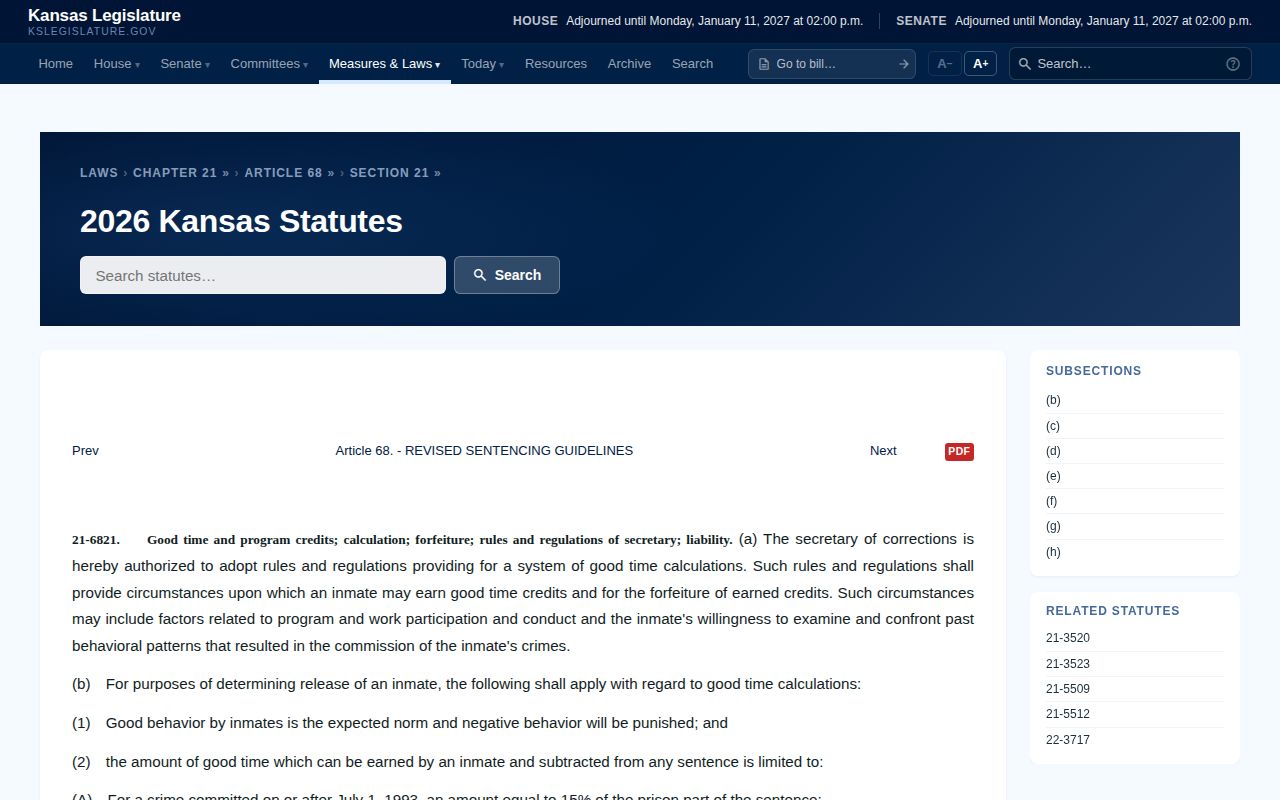
The statutory image confirms the limits, while KASPER shows the estimate produced for an individual record. KDOC Sentence Computation remains the best source for multiple cases, consecutive terms, jail-credit disputes, or later recalculation.
Why Greeley Release Dates Change
An anticipated release date can move in either direction. KDOC warns that good-time and program-credit earnings or forfeitures affect the displayed date. A court can amend a sentence or correct jail credit. Another agency may lodge a detainer, which is a request to hold or transfer the person for a separate case. A revocation can return someone from community supervision to custody. Multiple concurrent or consecutive terms require the controlling sentence to be identified.
| Factor | Possible effect | Confirmation source |
|---|---|---|
| Good time | Earned, lost, or restored credit changes the estimate | KASPER and KDOC computation |
| Program credit | Eligible credit may reduce time within statutory limits | KDOC record and governing statute |
| Jail credit | Credited pre-sentence custody affects time remaining | Sentencing order and KDOC computation |
| Court order | Amendment or resentencing changes the legal term | Filed journal entry |
| Detainer or hold | Can change the destination from community to another custodian | Holding agency and receiving authority |
| Violation or revocation | Can interrupt release or return the person to custody | Court, KDOC, and supervision record |
Parole decisions add another layer in older indeterminate cases. A person may reach eligibility, receive a hearing, and receive a Board outcome before actual processing. For guidelines-determinate cases, the Board more often sets conditions and reviews the release plan. In both settings, the future date should be separated from the completed release transaction.
A destination also changes the meaning of the event. Release from a KDOC institution to parole or postrelease supervision places the person outside prison but still under state jurisdiction. Delivery to another county, federal authority, or immigration authority is a transfer. A medical movement may likewise preserve custody. Ask which agency received the person and whether the record says community release, transfer, or supervision. A date without that destination can answer when one custodian’s control changed but not whether the person was free to leave.
Older Greeley Release Computations
Older indeterminate sentences do not fit the modern shorthand. K.S.A. 22-3725 contains an older good-time table and expressly does not apply to crimes committed on or after July 1, 1993. K.S.A. 22-3717 governs parole eligibility and conditional release through detailed rules tied to offense and sentence dates. Off-grid offenses and mandatory minimums can prevent reduction or parole before the required minimum.
The older-law statute is captured in the matching project image:
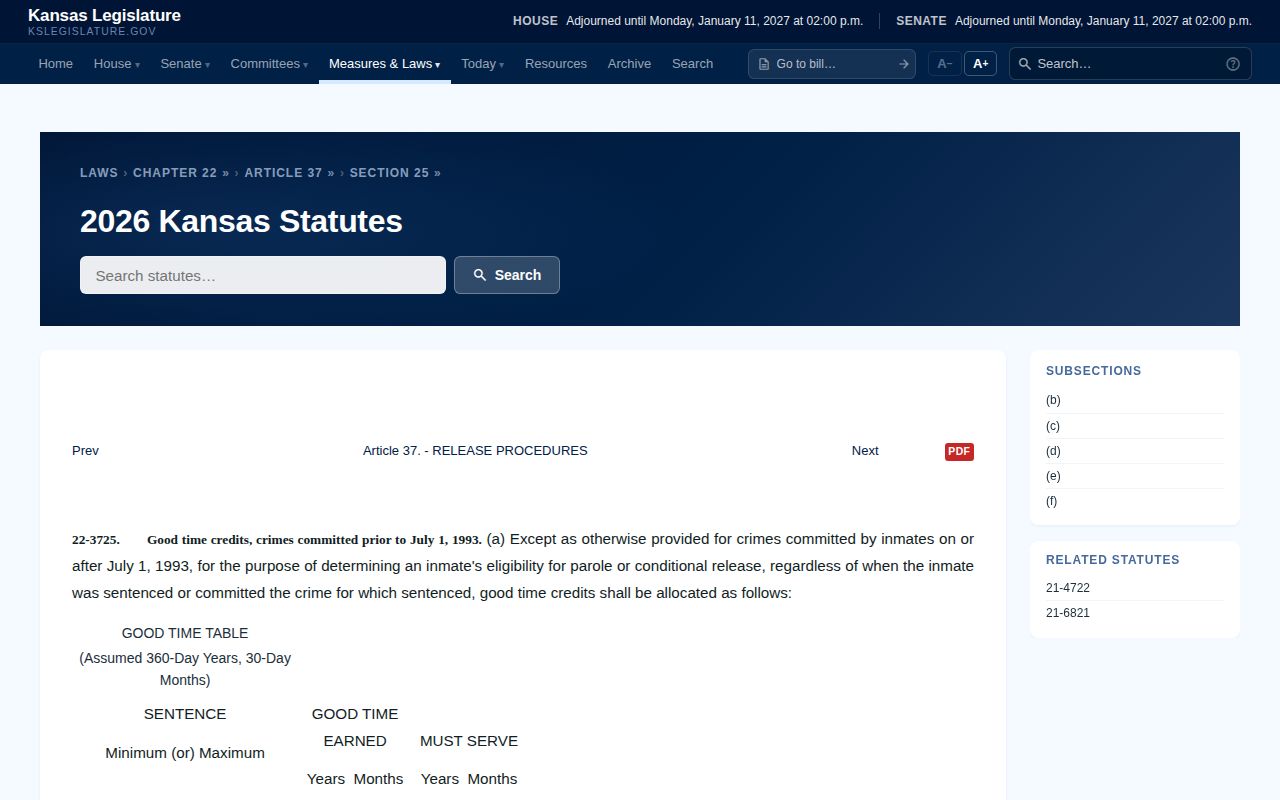
This separate framework is why the live KASPER field should be used as a lead, not recreated with informal arithmetic. Read the sentencing journal entry, identify the offense and sentence regime, and ask KDOC to confirm the controlling computation.
Confirm Greeley Actual Release
For a state prisoner, compare the final KASPER status with KDOC confirmation. A supervision label means the person may be outside prison while still under state jurisdiction. A discharge status is stronger evidence that the shown KDOC sentence has ended. For a Greeley County jail term, ask the physical custodian for the actual release date, time, type, authority, and destination. A court order explains why release was authorized but may not show when processing finished.
Kansas VINE covers participating county-jail feeds, not KDOC state prisons. It can provide a custody-change alert for a county person, but the reporting jail’s record remains the final local confirmation. The Greeley County VINELink inmate search explains that specific-person notification path. For state custody, use KASPER and KDOC’s separate qualifying notification service.
Record the time zone when comparing dates. Greeley County lists Mountain Time, while statewide system timestamps may follow their own configuration. A midnight boundary can make an event appear on a different date. Preserve the source label, access date, and any conflict until the physical custodian resolves it.
Note: Use “anticipated release date” for an estimate and “release date” only after the responsible custodian records the actual event.