
Where Kansas Prison Releases Go
No KDOC prison is located in Greeley County. A defendant sentenced to state imprisonment leaves the county-jail track and enters KDOC custody. Later departure from a prison may begin parole, conditional release, postrelease supervision, compact supervision, or another form of state control. It may also be a final discharge. Being outside a prison does not alone mean KDOC jurisdiction has ended.
KASPER, the Kansas Adult Supervised Population Electronic Repository, can display prison, supervision, and qualifying historical information. Read the status together with location or maintaining parole office and the date fields. A supervision status supports that the person is outside institutional custody under conditions. A discharge status and date are stronger evidence that KDOC jurisdiction ended for the displayed sentence, although other cases or authorities may still exist.
For a Greeley County releasee under state supervision, the official KDOC directory assigns the Garden City Parole Office. A court probation case is different and must be checked through the Greeley County District Court and the responsible court-services or community-corrections channel.
Confirm a Kansas Prison Release
Open KASPER’s disclaimer and accept it. Search by KDOC registration number for the least ambiguous match, or use the legal name and compare all available identity details. Open the detail record rather than relying on the results list.
- Confirm the KDOC number and identity fields.
- Copy the status exactly as displayed.
- Record facility, movement, or supervision information.
- Distinguish an anticipated date from an actual release or discharge date.
- Save the access date and obtain KDOC confirmation when timing matters.
KASPER may show convictions, county and case number, sentence information, placement or movement dates, a parole office, a photograph, and custody or supervision categories. Not every record has every field. A photo is an identity aid, not proof of current custody. The Greeley County released inmate search provides the separate county-jail and court paths.
KDOC says its public repository covers people sentenced to the Secretary of Corrections since 1980 who are incarcerated, under post-incarceration supervision, or discharged from a sentence. It does not include Kansas people held through interstate compact. Updates occur daily except weekends, and qualifying names can remain unless an appeal, expungement, or executive-clemency event changes access.
KDOC Release Records and Contacts
Kansas Department of Corrections
714 SW Jackson, Suite 300
Topeka, KS 66603
Central: (785) 296-3317
Records Division: (785) 746-7470
Email: KDOC_Pub@ks.gov
Ask KDOC for an official release or discharge record when the public display is not enough. A focused request identifies the person by full name and KDOC number, states the relevant sentence or case if known, and seeks the actual release date and type, supervision start, discharge date, movement history, or discharge certificate. Request only the record needed and expect protected information to be withheld.
Questions about disputed date calculations, multiple cases, consecutive terms, jail credit, revocation, old-law sentences, or a court amendment should go to KDOC Sentence Computation through the locating contact. Do not calculate a release date from a news report or one docket entry. Preserve the displayed labels and the agency’s response.
Kansas Adult Facility System
KDOC operates Kansas state prisons and the Community and Field Services structure that handles parole and postrelease supervision. It is not the custodian for every person arrested or briefly jailed in Greeley County. A misdemeanor or pretrial stay that never became a state sentence may have no KASPER record.
The adult-facilities directory identifies the institutions, but a directory page is not proof that a specific person remains there. KASPER’s movement and location data, confirmed through KDOC, are the better person-level route. The official facilities view below is useful for understanding the statewide institution system.
View the official Kansas adult correctional facilities directory.
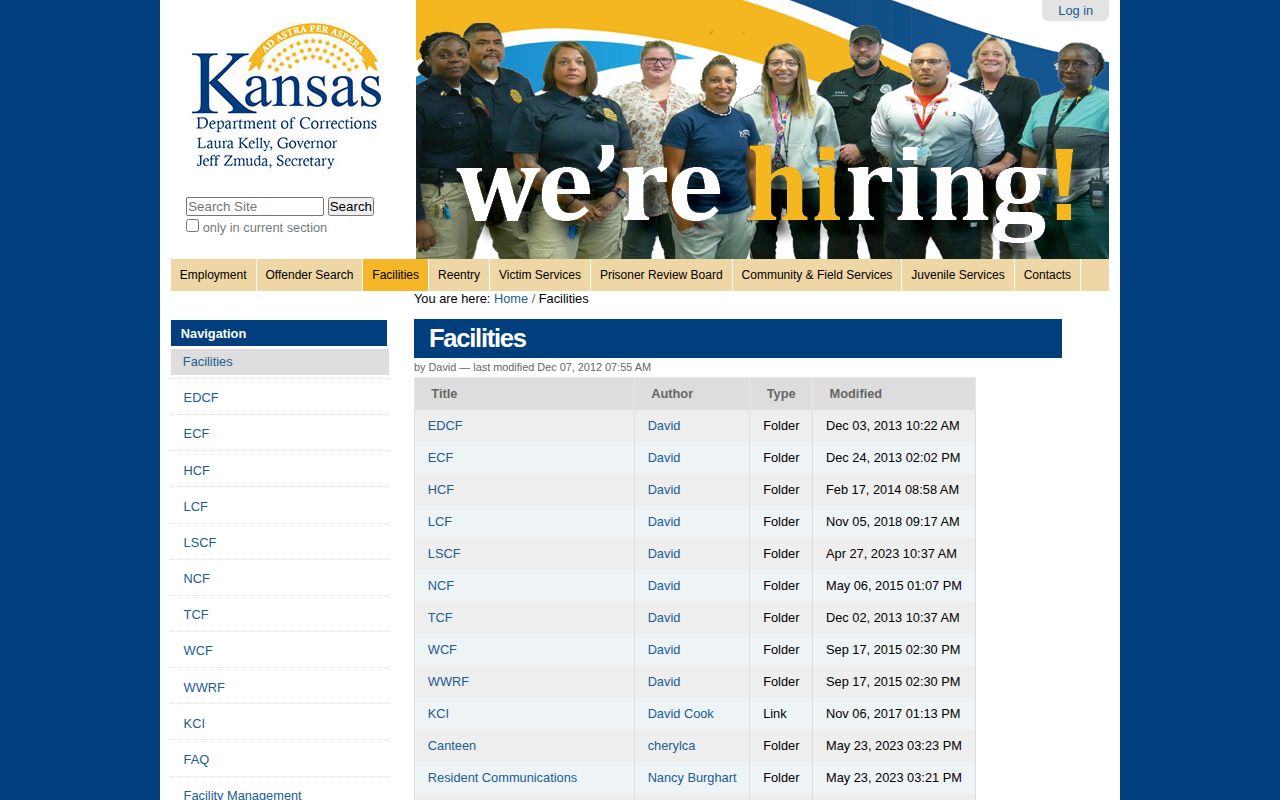
The directory shows the state correctional network serving Kansas cases. It does not establish a Greeley defendant’s release status without the matching KASPER or KDOC record.
Kansas Anticipated Release Date
KASPER’s documented field name is “Anticipated release date.” It is prospective. It can change with sentence structure, jail credit, earned or forfeited good time, eligible program credit, detainers, court changes, revocation, or recalculation. Never rewrite it as an actual release date.
Kansas guidelines prison terms are actual time subject to authorized credits. The familiar 85-percent shorthand arises from a general statutory maximum reduction of 15 percent, but specified lower-severity categories and dates can permit 20 percent. Defined programs may yield additional credit for eligible people. Special offenses, mandatory minimums, and older sentence laws create other rules. No single subtraction works for all records.
After an anticipated date passes, look for a status or movement update. Confirm whether the person entered supervision, transferred, remained confined after recalculation, or was discharged. The actual event needs an actual status or release record.
Greeley State Release Supervision
Garden City Parole Office, South Region
816 N. Campus Drive, Suite 500
Garden City, KS 67846
(620) 960-1275
Automated Reporting System: (866) 570-7225
KASPER may identify parole, conditional release, postrelease supervision, or compact supervision and show the maintaining office. Parole generally concerns release under conditions in eligible older cases. Postrelease supervision is the community-control period that follows many determinate prison terms. Discharge is the end of the relevant KDOC sentence or jurisdiction.
For old-law cases, the Kansas Prisoner Review Board may decide parole suitability. Its monthly schedules and lists identify people approaching consideration, not final release results. Obtain the individual decision from PRB or KDOC, then verify actual movement in KASPER. For most guidelines cases, the Board sets conditions or reviews the plan rather than deciding ordinary release suitability.
Prove a Kansas Final Discharge
A person can be outside prison and remain within KDOC jurisdiction. For a final-discharge claim, seek a KASPER discharge status and date, a maximum-sentence discharge certificate when applicable, or written KDOC verification. Compare the state record with the sentencing journal entry and any later court modification.
If sources conflict, record each source’s access date and scope. KASPER is the statewide public lead. The court explains the imposed sentence. KDOC controls its custody, computation, supervision, and discharge records. A Greeley sheriff record can document the earlier county-to-state transfer but cannot certify the later prison release.
Match Kansas Release Identity Fields
A name alone is not enough to merge records. KASPER may display the KDOC registration number, date of birth, physical description, body markings, photograph, conviction county, and case number. Compare several fields before treating a result as the Greeley County defendant being researched. Preserve the record’s status and access date because supervision and location data can change.
The photograph is only one identity aid. It does not prove current custody, and a missing photograph does not disprove a match. If two people share a name, rely on the KDOC number, birth information, case number, and displayed conviction data. When a public field conflicts with a court record, ask KDOC to resolve the correctional record rather than editing the facts through inference.
Verify Kansas Sentence Computation
A precise computation review begins with the sentencing journal entry, controlling cases, sentence-begins date, and jail credit. It then accounts for concurrent or consecutive terms, earned and forfeited credit, program credit where authorized, revocation, court amendments, detainers, and any mandatory minimum. A single pronounced sentence does not show all of those inputs.
Older indeterminate cases use parole eligibility and conditional-release rules that differ from current guidelines sentences. Off-grid and specified life sentences can have special minimums or no-parole provisions. A parole eligibility date marks the first possible consideration point, not a promise of release. A Prisoner Review Board decision also precedes physical processing and should be followed by a KASPER movement or status check.
When legal precision matters, gather the source documents and contact KDOC Sentence Computation. Quote the public field exactly as “Anticipated release date” if that is what appears. Do not substitute a homemade projected date.
Request a KDOC Discharge Record
For a durable endpoint, provide the full name, KDOC registration number, case or sentence details, and a narrow description of the existing record. The request may seek the actual prison-release transaction, supervision start, discharge status and date, or a discharge certificate. Asking for a defined record helps KDOC route the request and separates public correctional fields from protected material.
Kansas correctional-record law identifies certain fields that may be public, but exceptions still apply. Request nonexempt portions if a record contains protected information. A response from KDOC Records Division is stronger proof of state discharge than disappearance from a county page or an unverified statement about being “out.”
KASPER’s continued display of an older discharged record can be useful after a local jail trace has disappeared. Its absence still requires care because overturned convictions, expungement, clemency, identity variation, or scope limits may affect public access. Treat the repository as the correct statewide starting point, not as a substitute for the official correctional file.