
Greeley Parole and Probation
Release from a jail or prison does not always end a case. The next status depends on the sentence and the agency with legal control. A person released from a Kansas Department of Corrections facility may move to parole, conditional release, or postrelease supervision. A person released from the Greeley County Jail after a local sentence may instead report under a district-court probation order. Someone released on bond is awaiting further court action and is not on probation merely because the person is out of jail.
These distinctions matter when a name no longer appears in custody information. KASPER, the Kansas Adult Supervised Population Electronic Repository, covers people in KDOC custody, under post-incarceration supervision, and selected discharged records. It does not cover every county-only probation case. The Greeley County District Court docket is the durable source for a local probation sentence, revocation, termination, or discharge. The office that held the person should separately confirm whether the jail exit was a community release or a transfer.
| Status | Who imposes or maintains it | Best verification route |
|---|---|---|
| Parole | KDOC and the Prisoner Review Board in applicable older cases | KASPER, then KDOC or the assigned parole office |
| Postrelease supervision | KDOC Community and Field Services | KASPER status and maintaining office |
| Probation | Greeley County District Court | Court docket, sentencing order, and court-services channel |
| Discharge | The agency or court ending its jurisdiction | Discharge entry, certificate, order, or official records response |
Verify Greeley Post-Release Supervision
Begin with the custody history, not a guess. If the person served a KDOC prison sentence, use the KASPER search disclaimer and entry. A KDOC registration number gives the strongest search key. When searching by name, compare the date of birth and physical details shown before relying on a match. Read the displayed status, supervision type, maintaining office, sentence fields, and dates together.
- Confirm whether the person left the Greeley County Jail, a KDOC prison, or another custodian. A transfer is not a community release.
- For KDOC history, search KASPER and open only a record supported by more than a shared name.
- Record the exact supervision label and the parole office shown. Do not convert “parole,” “conditional release,” and “postrelease supervision” into one term.
- For county probation, search the Greeley criminal case for the sentencing order, revocation entries, and a later termination or discharge order.
- Ask the maintaining office or court clerk to clarify public status information when the record is unclear or dates conflict.
A KASPER label showing supervision supports that the person is outside institutional custody but remains subject to KDOC control. It does not prove that every other case has closed. Likewise, a missing KASPER record does not show that Greeley County probation ended. Court probation can exist without KDOC coverage, so its end must be established by the court record or responsible local program.
Greeley Parole Office Assignment
KDOC assigns Greeley County to the Garden City Parole Office in its South Region. KASPER may name the maintaining office on the individual record. That person-specific field should be checked first because assignments can change. The Garden City office is the local fallback for questions about state parole, conditional release, or postrelease supervision tied to Greeley County.
Garden City Parole Office, South Region816 N. Campus Drive, Suite 500
Garden City, KS 67846
(620) 960-1275
Automated Reporting System: (866) 570-7225
The KDOC parole-services directory documents this Greeley County assignment. Its office page also gives a visual check on the address and phone information:

The directory confirms where to route a state-supervision question, but staff may limit case-specific details. Call only after identifying the right person and having the KDOC number or another reliable identifier ready. The office is not the ordinary source for county-only court probation.
Greeley Probation Court Records
Greeley County criminal cases belong to Kansas’s 25th Judicial District. A sentencing journal entry can state that probation was ordered and identify its term or conditions. Later docket entries may show a violation allegation, revocation, modification, or termination. Search by case number when possible. A name-only search is more prone to a mistaken identity and should be checked against the case details.
The Greeley County District Court is the right local starting point when the sentence never placed the person under KDOC. Online access can omit sealed, expunged, protected, older, or not-yet-indexed material. Ask the clerk about the docket or an available order when the public portal lacks the needed entry. The jail release timestamp and the court’s probation order serve different purposes: one proves the custody event, while the other defines the legal supervision.
- Parole
- Community supervision following release under an older parole-eligible sentence and a Board decision where required.
- Postrelease supervision
- KDOC supervision that follows the prison part of many determinate Kansas sentences.
- Probation
- A court-ordered sentence served in the community under stated conditions.
- Discharge
- The formal end of the relevant sentence or supervision jurisdiction.
- Absconder
- A supervised person alleged to have knowingly avoided supervision or made their whereabouts unknown.
Greeley Supervision Warrants
A warrant or absconder notation changes the verification path. Kansas law at K.S.A. 75-5217 addresses warrants for people on parole, conditional release, postrelease supervision, and certain compact supervision. It describes absconding in terms of knowingly avoiding supervision or making one’s location unknown. That status does not establish that the person is currently held in the Greeley County Jail.
KDOC lists an absconder-tip line at (785) 746-7620. Greeley County does not publish a local absconder or warrant list in the researched sheriff channels. For a custody question, ask the sheriff whether the person is actually booked and which authority issued any hold. For a state-supervision status, compare KASPER with the maintaining office. A court-probation warrant should be traced in the district-court case.
The official statute page illustrates the scope of Kansas supervision warrants and absconding rules:
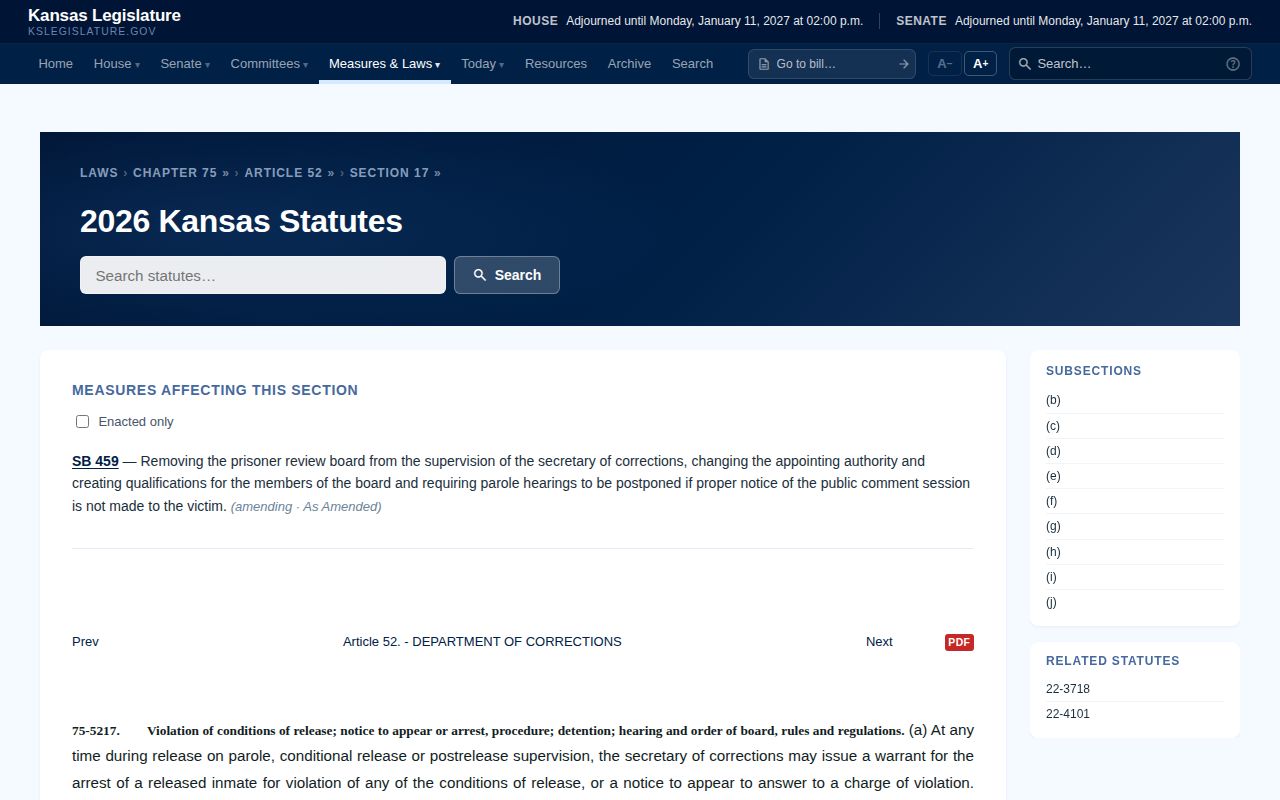
The statute supplies legal context, while the live court, jail, or KDOC record supplies the person’s present status. Never infer present custody from an old warrant entry alone.
When records disagree, keep each agency’s role separate. The sheriff can confirm an actual Greeley County booking or local release. The district court can confirm a probation order or a warrant filed in the criminal case. KASPER and the Garden City Parole Office address KDOC supervision. One office should not be asked to certify another system’s event. Record the date each source was checked, the exact label it used, and the identifier supporting the match. A later entry may replace an earlier status without making the older entry false for its own date.
Greeley Parole Decision Path
Not every Kansas prison release depends on the same Board decision. Most guidelines-determinate cases use a fixed sentence structure adjusted by authorized credits. In those cases, the Kansas Prisoner Review Board generally sets conditions and reviews the release plan rather than deciding ordinary release suitability at an old-law hearing. Older indeterminate cases may require an affirmative parole decision before release processing begins.
The Prisoner Review Board process recognizes outcomes such as parole, continue, and pass. Public schedules and lists concern upcoming consideration. Research found no public person-level decision-results search. Obtain an individual decision through the Board or KDOC, then use KASPER or a KDOC record to confirm whether release actually occurred. A favorable decision can precede the physical prison exit.
The Board’s process page shows how those outcomes fit the Kansas review system:

The process image is useful for reading a decision, but it cannot replace the release event or current supervision status. Eligibility, hearing, decision, release, and discharge are separate milestones.
Public Board calendars also have a limited purpose. They show upcoming processes and listed people, not a permanent public database of individual results. A “parole” outcome means the Board approved release subject to processing and conditions. “Continue” means consideration was deferred for more information or evaluation. “Pass” means parole was denied for a stated period. None of these labels alone supplies the actual gate date. Request the person-specific decision from PRB or KDOC when needed, and then compare it with KASPER’s later status.
Ending Greeley Release Supervision
Final verification requires an endpoint document. For older state supervision, jurisdiction may continue until maximum sentence expiration, though an early-discharge process can apply after the required period. At maximum sentence, KDOC or PRB supervision ends and the Board issues a maximum-sentence discharge certificate. A KASPER discharge entry or a KDOC records response can also support the end of state jurisdiction.
County probation ends through the court process. Look for an order terminating or discharging probation, not just a period with no new docket entry. A supervision term can be modified, revoked, or extended under the controlling case. If the end date affects a court or records request, obtain the actual order or certificate. The Greeley County released-inmate search and records path explains how to pair that legal endpoint with the earlier physical release record.
Keep the custody and supervision timeline in order: jail or prison release, supervision start, any warrant or revocation, supervision end, and final discharge. This prevents “out of prison” from being reported as “all jurisdiction ended.”
Note: KASPER is updated on its own schedule, so preserve the access date and seek agency confirmation for a disputed supervision endpoint.