
Where Federal Custody Can Go
No Bureau of Prisons institution, dedicated ICE detention center, or separately verified U.S. Marshals facility is located in Greeley County. A federal connection may still arise when a person is moved from a local jail under a detainer, writ, or federal court order. That movement ends the county’s physical custody but does not establish release to the community.
A sentenced federal prisoner may move through BOP institutions and later leave prison with a recorded release date. Federal supervised release, imposed by a court, can continue afterward. An ICE detainee may be released from civil immigration custody while immigration proceedings continue. A person in USMS custody may move among contract beds, appear in federal court, be acquitted or released by order, or be delivered to BOP after conviction.
Always name the custodian. “Released from BOP,” “released from ICE custody,” and “released by federal court order from USMS detention” answer different questions. None alone proves the person is free of all local, state, federal, immigration, or supervision obligations.
Confirm a Federal Inmate Release
- Identify BOP, ICE, or USMS as the relevant custodian.
- Search with the correct register number, A-number, or biographical details.
- Copy the displayed status and date without broadening its meaning.
- Check the federal court docket for sentence, detention, release, and supervision orders.
- Use the responsible agency’s records or FOIA route for durable confirmation.
When the path began at Greeley County Jail, ask the sheriff only what its transfer record shows: the date, time, receiving authority, and whether the movement was a transfer. Then continue with the receiving federal system. The Greeley County released inmate search covers the local starting record and court cross-check.
Match identity with more than a name. Useful identifiers include date of birth, BOP register number, A-number, federal case number, and physical descriptors shown by the lawful source. If two sources conflict, keep both access dates and agency scopes while seeking the physical custodian’s record.
Federal Release Record Routes
Federal records are not held by the Greeley County sheriff merely because the person once passed through the county jail. BOP records route through the inmate locator and BOP FOIA. ICE custody checks begin with ODLS and agency detention channels. USMS prisoner records require a sufficiently specific FOIA request, while the federal court docket supplies detention, release, sentencing, and supervised-release orders.
System-specific starting points
BOP: Inmate Locator and BOP FOIA
ICE: Online Detainee Locator System
USMS: Prisoner Operations and USMS FOIA
Court: federal docket or PACER
A records request should include the federal identifier, full name, date of birth, relevant district and case number, approximate date range, and the exact record sought. Ask for the release date and type, transfer or receiving authority, or movement record as appropriate. Broad requests can delay review and may encounter privacy or law-enforcement limits.
Three Distinct Federal Systems
BOP is a prison agency. ICE civil detention concerns immigration custody. USMS manages prisoners tied to federal court proceedings and transport, often using contracted state, local, or private beds. Combining their results into one generic “federal inmate search” can produce false conclusions.
BOP Federal Release Search
Use the BOP inmate locator for federal prison records. Search by the register number in its standard format for precision, or use an offered DCDC, FBI, or INS number. A name search can be refined by age, race, and sex. Results may display name, register number, age, race, sex, release date, and location or status wording.
A past date with “Released” or “Not in BOP custody” is evidence about BOP custody only. “Not in BOP custody” does not prove that every form of federal jurisdiction ended. Review the federal docket for supervised-release conditions and any later case. Future dates can also change through sentence calculations.
Open the official BOP Inmate Locator.
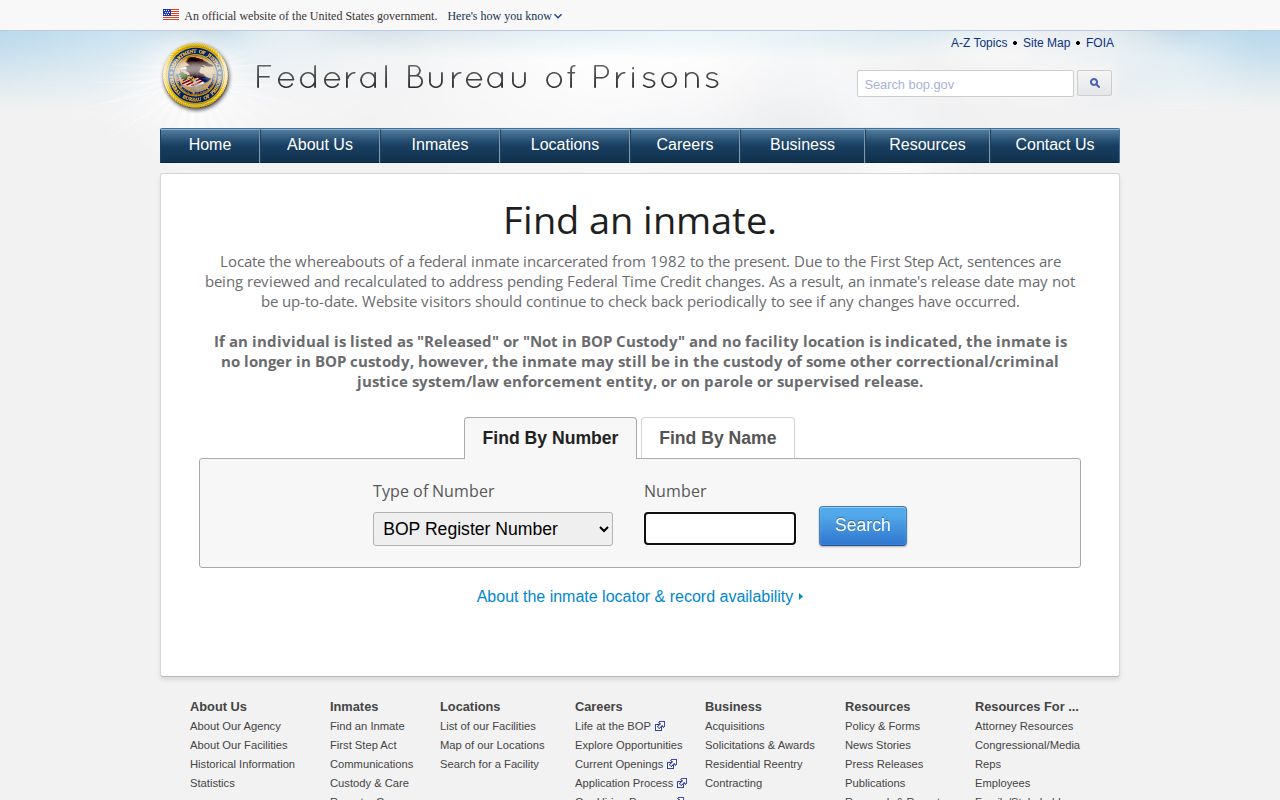
The locator’s number and name modes help separate federal prison research from county and immigration custody. Use the result as a lead, then obtain the official record if the exact event matters.
Federal Release History Has Limits
BOP updates its locator daily and generally covers records from 1982 forward. Earlier federal prison records route to the National Archives with the person’s identity and approximate confinement details. This creates durable visibility for many old BOP releases, but the locator still does not answer later custody or every supervision question.
The BOP records explanation details that scope and the limits of a displayed date. Its historical reach differs sharply from ICE’s short recent-release window. Record the access date and exact wording so a later reader can understand what the system showed at that time.
Read BOP’s official locator records explanation.
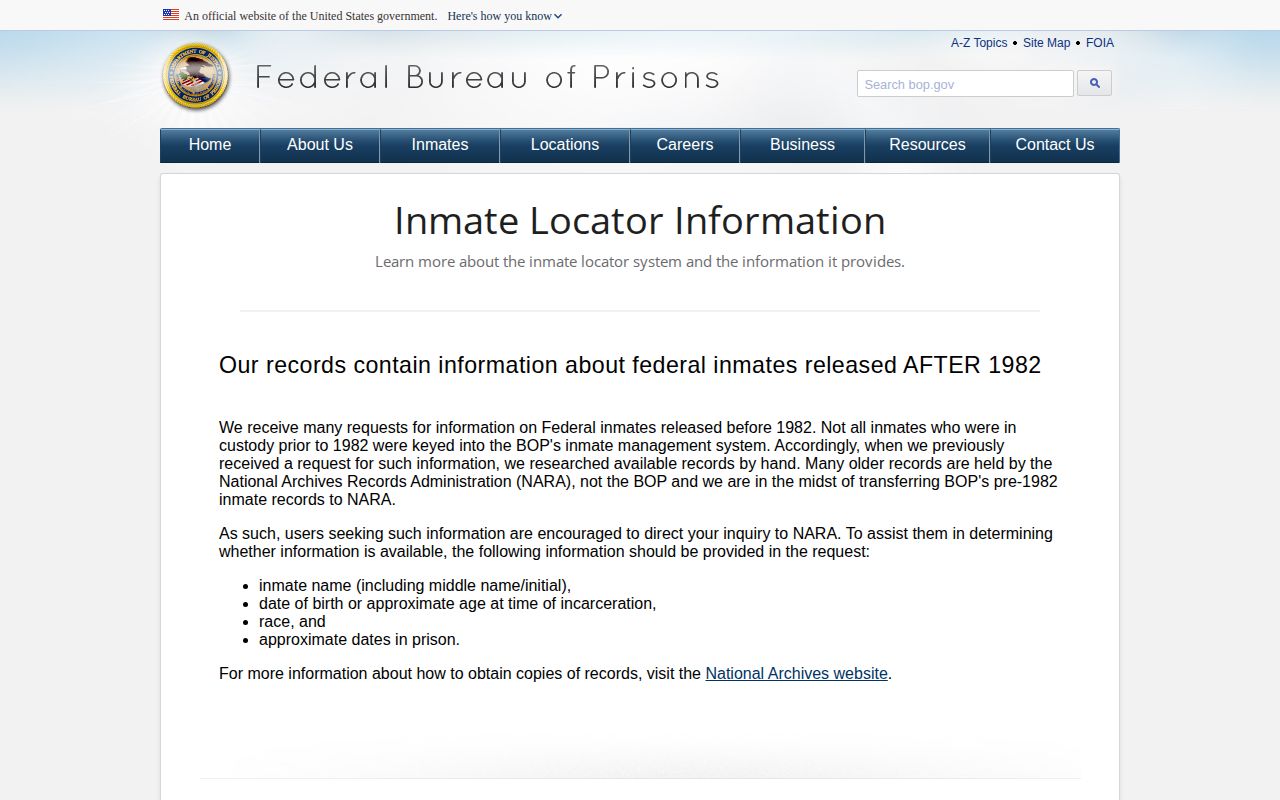
The explanation shows why pre-1982 research and formal documentation may require a different records route.
ICE Recent Release Lookup
ICE’s Online Detainee Locator System accepts an A-number with country of birth or a biographical search using full name, date of birth, and country. ICE states that the system includes people currently detained and people released from ICE custody within the prior 60 days. Save the access date because a recent-release result can age out.
ODLS is not a permanent release archive. A no-result after the visibility window does not prove that ICE never held the person. “Released from ICE custody” also does not decide immigration status or close the immigration case. Use the authorized immigration case channel for proceeding information and keep that issue separate from the custody record.
No dedicated ICE detention center or verified county ICE contract was found in Greeley County. Do not label a local jail exit as an ICE release without a detainer, transfer, or receiving-agency record.
USMS Transfers and Release Proof
The U.S. Marshals Service has no comparable public historical inmate locator. It holds federal defendants from court-ordered detention through acquittal, conviction, release, or transfer to BOP. Contract facilities may change, so disappearance from a county display can mean transport between beds rather than freedom.
Use the federal docket to locate the detention order, release order, judgment, or commitment. PACER may provide the case history, subject to its access system. For the prisoner movement itself, use the responsible Marshals district and USMS FOIA with a specific identifier and date range. Delivery to BOP should be called a transfer, not a USMS community release.
When a local and federal record meet, create a timeline: Greeley relinquished custody, USMS received or transported the person, a court acted, and BOP received the sentenced prisoner if applicable. Each row needs its own source.
Federal Release Visibility Windows
Federal systems have notably different post-release visibility. ICE ODLS includes a recent ICE release only within a limited 60-day period, while BOP retains covered historical federal release results from 1982 forward. USMS offers neither type of public historical locator.
That contrast is a search design issue, not proof that one agency is more accurate. Choose the system based on custody type and date. None of the three replaces Greeley County’s own booking, release, or transfer transaction when the question began with a county arrest.
Use the Federal Court Docket
The federal docket supplies legal context that an agency locator may omit. Review the detention order, release order, judgment, commitment, and supervised-release conditions in the correct district and case. An order can explain why custody changed, but it may not state the exact time that a jail or federal facility completed movement.
Pair the docket with the physical custodian’s transaction. For a BOP sentence, the judgment and locator result answer different parts of the history. For USMS pretrial detention, the court order and Marshals movement record should be read together. If ICE later obtained custody, add a separate row rather than treating that handoff as part of the criminal sentence.
Build a Precise Federal Request
A useful federal records request identifies the agency before describing the record. For BOP, provide the register number, full name, birth date, approximate institution, and date range. For ICE, provide the A-number, country of birth, and the detention or release period. For USMS, include the federal district, case number, relevant dates, and the movement or prisoner record sought.
Ask for the specific release, transfer, designation, or movement record rather than an unlimited file. Privacy rules, law-enforcement exemptions, and identity requirements may restrict production. When requesting a record about oneself, follow the agency’s identity-verification instructions. When the record concerns another person, expect the agency to apply applicable disclosure limits.
A negative locator result is not the same as a negative records response. BOP’s public coverage begins in 1982, ICE recent-release visibility expires, and USMS has no public historical locator. An agency-specific request can therefore be necessary even when the web search is blank.
Label Federal Release Terms Exactly
Use “release date” only when the source records an actual release. Use “transfer” for movement between custodians, “delivered to BOP” for a USMS handoff after sentencing, and “released from ICE custody” only for the civil detention event. “Not in BOP custody” must remain limited to BOP’s scope.
Record the source date, time zone when available, and access date. If two systems disagree, show the conflict and contact the agency that physically held the person at the disputed point. This method avoids turning a county disappearance, federal transfer, or short-lived ICE result into an unsupported claim of full release.