
Greeley County Release Records
A release is an event tied to one custodian. It answers who was held, which agency held that person, when physical custody ended, and what authority or destination ended it. The Unified Greeley County Sheriff's Office holds the local booking and release transaction. The Greeley County District Court holds orders that may explain bond, dismissal, sentence, probation, or commitment. Kansas Department of Corrections records cover state prisoners and people on state postrelease supervision. Federal Bureau of Prisons, ICE, and U.S. Marshals records cover separate federal paths.
A name disappearing from a list does not prove freedom. It may reflect release on bond, completion of a jail term, a court order, dismissal, transfer to KDOC, movement to another county, a federal or immigration hold, medical movement, escape, death, or a data correction. “Transfer” means custody changed hands. “Discharge” means the named sentence or agency jurisdiction ended. A person outside prison may still be on parole or postrelease supervision. Each term points to a different record and must be reported as written.
Greeley County Release Types
The words on a release transaction matter more than a simple “not in jail” result. The sheriff's record can distinguish a person who walked out under a bond order from one delivered to another custodian. The court docket often supplies the legal reason, while the physical holder supplies the door-out time.
| Release type | Meaning | Next record |
|---|---|---|
| Bond or own recognizance | Community release while the criminal case continues | Sheriff transaction and bond order |
| Sentence served | The ordered custodial part ended | Release record and sentencing entry |
| Dismissal or court order | Legal authority directed release | Journal entry plus actual jail transaction |
| Probation disposition | Community supervision may replace or follow confinement | Court probation order |
| Transfer | Another county, KDOC, BOP, ICE, USMS, or other authority took custody | Sending and receiving agency records |
| KDOC release or discharge | Prison ended, with supervision possibly continuing, or KDOC jurisdiction ended | KASPER and KDOC confirmation |
What Greeley Release Records Show
Greeley County does not publish its jail release fields online. Ask for the booking record, release transaction, jail register entry, and any code legend needed to read the response. Supply a full legal name, aliases, birth date if known, approximate booking and release dates, and a case or incident number. That detail helps the custodian avoid a same-name match.
| Field | What it shows |
|---|---|
| Booking number | Links the release to the correct local custody episode |
| Booked and released timestamps | The recorded start and end of that jail event |
| Arresting and holding agency | Who made the arrest and who had physical custody |
| Charge and case number | Connects the jail event to the district-court file |
| Release type and authority | Bond, order, sentence completion, transfer, or other basis |
| Destination or transfer notation | Whether the person entered the community or another agency's custody |
| Booking photograph | An identity image if retained and lawfully produced |
The jail transaction is the best local timestamp. A court order may have been entered earlier, and staff still had to process it. Report both when they differ: the court authorized release at one time, and the sheriff recorded physical release at another.
Ask which record series produced the response. A booking and release report, jail register, incident report, and computer-aided dispatch entry can hold different fields and may face different exemptions. If staff returns only a cover sheet, ask whether the jail-management system contains a separate release event. Also request the field legend when a disposition appears as a short code. The goal is not more paper. It is a record that clearly identifies the event, its time, its legal basis, and the next custodian when one exists.
Request Greeley County Release Records
The Unified Greeley County Sheriff's Office accepts report-copy inquiries by phone or in person during business hours. For a durable answer, submit a narrow Kansas Open Records Act request to the records custodian. Describe existing fields instead of asking staff to research or create a new list.
- Identify the person with name, aliases, birth date if known, booking or case number, and the date range.
- Ask for the booking and release transaction, exact date and time, release type, authority, destination, and code legend.
- State whether a booking photograph is also requested. The photo can be treated differently from the rest of the file.
- Ask for nonexempt portions if part of the record is withheld and request the legal citation for a denial.
- Compare the response with the district-court order or the receiving custodian's record when a transfer appears.
208 Harper, P.O. Box 690, Tribune, KS 67879
(620) 376-4233, fax (620) 376-2418
Dispatch is available 24 hours. County offices list Monday through Friday, 8:00 a.m. to 4:00 p.m. Mountain Time.
Kansas law allows reasonable actual-cost fees and advance payment. No exact Greeley copy charge is published. A custodian must act on a request as soon as possible and by the end of the third business day, but that rule does not promise production within three days. A delayed response should state the cause and earliest expected availability.
A narrow request controls cost and reduces identity mistakes. Give a defined Mountain Time range, ask for named fields, and accept redaction of protected parts. Kansas law permits an itemized fee statement. When staff work is expected to exceed five hours or $200, the agency must reasonably try to work with the requester on cost mitigation. Those thresholds do not establish the likely price of a Greeley record. They explain why a focused request for one custody episode is more useful than a demand for every jail document.
Kansas Law on Greeley Releases
KORA, K.S.A. 45-215 through 45-223, sets Kansas access rules. Section 45-218 covers access, response, and written denial. Section 45-219 permits actual-cost fees. Section 45-221 lists records that may be closed, including parts of criminal-investigation files. Juvenile, medical, protected-person, security, sealed, and expunged information can also be withheld. Request segregable public portions instead of assuming the whole file is closed.
Greeley County publishes no fixed retention period or online visibility window. The applicable record schedule and the custodian's record series control. Kansas also treats release from confinement as a reportable criminal-history event under K.S.A. 22-4705, but that does not make every central-repository field public.
Find Released Greeley County Inmates
Start with the last known holder. Greeley's very small jail and lack of an online roster make that step crucial. The arresting county may not be the place that physically held or released the person.
- Call the sheriff at (620) 376-4233. Ask whether Greeley booked the person, whether another jail housed them, and whether the last event was release or transfer.
- Search Kansas VINE for a specific county-jail record and reporting agency. Treat an alert as a lead, then call the source jail.
- Search the Greeley County criminal case through the Kansas district-court portal. Look for bond, dismissal, sentencing, probation, warrant, and commitment entries.
- For a state sentence, search KASPER by KDOC number or name. Read status, location, supervision, and date fields together.
- For federal custody, use the BOP locator, ICE ODLS, or federal docket that matches the custody path.
- Send a date-bounded KORA request when oral or online results do not provide a durable release transaction.
A released person normally leaves a current-custody view. Absence alone can also mean transfer, delay, spelling error, a protected record, or another custody system.
KDOC Search for Greeley Releases
KASPER covers people in Kansas Department of Corrections custody, on supervision, and selected discharged records. It does not cover every county-only jail stay. Search with a KDOC number when known, or use a full name and compare the displayed identifiers. Open the detail view and read the status with location, sentence, conviction, and date fields.
| Search or result field | Use |
|---|---|
| Name or KDOC number | Starts the match; the number is more precise |
| Demographics and descriptors | Helps separate people with similar names |
| Status and location | Shows prison, supervision, or a qualifying discharge state |
| Conviction and sentence data | Connects the record to the controlling state case |
| Anticipated release date | A changeable prospective date, not proof of release |
| Discharge status or date | Stronger evidence that KDOC jurisdiction ended |
The KASPER entry screen shows the disclaimer a searcher must accept.
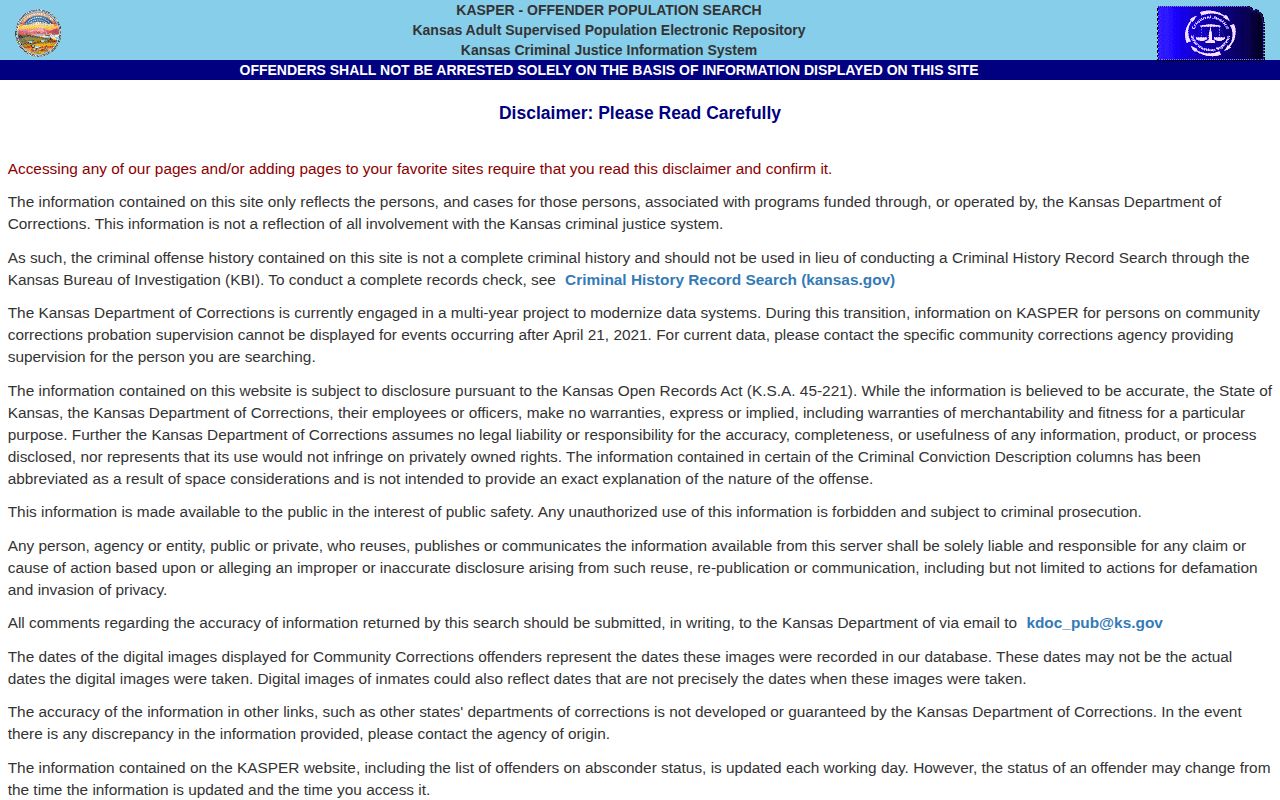
This statewide tool is the right path only after a Greeley case moved into KDOC custody.
A KASPER status showing parole or postrelease supervision means the person is outside the prison but still within KDOC jurisdiction. “Discharged” is the stronger end point. When an exact date has legal importance, request KDOC verification or a discharge record rather than relying on a saved search screen. KASPER fields can change as credits, court orders, revocations, and record updates are processed.
Greeley County Recent Releases
The sheriff publishes no 24-hour list, 72-hour list, current roster, release archive, or jail app. A blank search is not the finding. The finding is that no official browseable feed exists. Ask the sheriff for a specific Mountain Time interval and the release fields needed. Kansas VINE can check one person and send custody-change alerts, but it is not a guaranteed recent-release archive. Court records can explain legal action without proving the jail's door-out time.
Greeley County Release Supervision
Probation is imposed by a court, often instead of prison or after a short jail term. Parole applies to eligible older prison sentences. Postrelease supervision follows many Kansas guidelines prison terms. KASPER may show the maintaining state office, and Greeley County is assigned to the KDOC Garden City Parole Office. County probation is verified through the Greeley case and the 25th Judicial District, not by assuming every community status is parole.
An absconder is a person alleged to have stopped reporting or left supervision without permission. A warrant or violation can return the person to custody. The detailed Greeley County probation and parole record path separates each type and explains how discharge ends supervision.
Greeley Release Alerts and Federal Records
The sheriff links Kansas VINE for county-jail custody checks and notifications. Select Kansas, match the person and reporting facility, then register on the verified record for available release or transfer alerts. Feeds may lag. Kansas VINE does not cover KDOC prisons, so a state prisoner requires KASPER and KDOC's separate qualifying victim-notification route.
Federal records must stay separate. The BOP locator covers historical federal prison records and may show a release date or “Not in BOP custody.” ICE ODLS focuses on current detention and people released from ICE custody within the prior 60 days. USMS movement may be documented in a federal docket or transfer record. None proves what happened after a Greeley jail event without a complete custody timeline.
Compare Greeley Custody Records
Use the system that owned the event. Each source has a firm boundary.
| System | Still held | After release |
|---|---|---|
| Greeley County Jail | Call sheriff or check Kansas VINE | Request sheriff release transaction and court file |
| KDOC | KASPER prison status and location | KASPER supervision or discharge status, then KDOC confirmation |
| County probation | Not a jail custody status | Court order and supervising district |
| BOP | Federal locator facility/status | Displayed federal release date and federal docket |
| ICE | ODLS current locator | Recent release window, not a full history |
Greeley County Release Facilities
Greeley County Jail is the local starting point, but the Kansas Sheriffs' Association lists only three jail spaces. Ask who had physical custody. The Kansas Department of Corrections adult system covers a state-sentenced defendant after transfer from the county. Federal BOP, ICE, and USMS systems have no verified dedicated Greeley facility and use their own national and court records.
Greeley Release Orders and Times
Greeley criminal cases belong to the Kansas 25th Judicial District. The docket can preserve bond orders, dispositions, sentences, probation, and discharge-related entries long after a live custody status disappears. Yet a judge's release order and a jail's physical release are two events. Compare the entry time with the sheriff transaction instead of merging them.
The Greeley County District Court and the Kansas district-court records guide explain access. The statewide portal can omit sealed, expunged, confidential, older, or not-yet-indexed cases. Call the clerk with a case number when “no result” conflicts with a known arrest.
Why Greeley Custody Location Matters
The Kansas Sheriffs' Association reports a jail size of three, while the county site has no separate detention portal. That makes one question unusually important: which agency physically held the person at the moment of discharge? Greeley's record may document arrest and transport while another jail documents the actual door-out event.
The small size supports asking about placement outside the county. It does not support naming a receiving county without case-specific proof. If the sheriff identifies another holder, repeat the release request with that facility and compare both records.
Greeley Discharge Dates and Expungement
Under K.S.A. 21-6614, some Kansas expungement waiting periods run from satisfaction of sentence or discharge from supervision. The exact discharge date can therefore matter years after release. Eligibility is case-specific, and official Kansas Judicial Council forms do not replace legal advice.
An expungement order can later restrict public access to covered arrest, conviction, and incarceration records. A missing old result does not prove that custody never happened. It may reflect lawful sealing, an index limit, record retention, or a mismatch. Preserve the source and access date when documenting a release.
Why Greeley Releases Leave Records
Kansas law includes release from detention or confinement among reportable criminal-history events. That helps explain why a formal record may exist even though Greeley County offers no public release feed. The proper path remains the sheriff, court, or corrections custodian that owns the event. The reporting law does not create open access to every central-repository field.
Identity and time controls keep the search accurate. A full name alone is weak evidence. Compare a birth date, booking number, case number, KDOC or federal number, physical details, and reporting facility when those fields are lawfully available. Record the source's access date and time zone. Greeley County offices list Mountain Time, while a statewide or federal system may use another timestamp rule.
If two sources conflict, preserve both labels instead of choosing the more convenient one. Ask the physical custodian to resolve the gap. A VINE alert, court order, KASPER date, and sheriff transaction can each be accurate within its own scope while describing a different step in the same custody timeline.